Kyrgyzstan Presented Its Updated National Climate Plan – NDC 3.0
10 октябрь 2025
Bishkek, 10 October 2025 — Kyrgyzstan has presented its updated national climate plan — Nationally Determined Contribution (NDC) 3.0, outlining how the country will cut greenhouse gas emissions and adapt to the impacts of climate change through 2035.
The adoption of NDC 3.0 marks a strategic milestone for the country. The document aligns fully with the Paris Agreement, the National Development Programme – 2030, and the Sustainable Development Goals (SDGs). Although Kyrgyzstan contributes less than 0.034% of global emissions, it is already experiencing the intensifying consequences of climate change. The new plan aims not only to protect the nation from growing climate risks but also to strengthen its economy and accelerate a green, resilient future.
“NDC 3.0 is a data-driven, inclusive and forward-looking framework that defines Kyrgyzstan’s strategic position ahead of COP30,” said Edil Baisalov, Deputy Chair of the Cabinet of Ministers of the Kyrgyz Republic.
“The document reflects both the climate realities and the potential of our country. It recognizes the vulnerability of mountain ecosystems, the growing pressure on water resources and the need for a just transition for all regions and communities,” noted Meder Mashiev, Minister of Natural Resources, Ecology and Technical Supervision of the Kyrgyz Republic.
Antje Grawe, UN Resident Coordinator in Kyrgyzstan, emphasized that “NDC 3.0 recognizes that a low-carbon transition can only succeed if it is just and inclusive. This people-centered approach ensures that climate action supports livelihoods and social cohesion while driving sustainable economic transformation.”
She also highlighted the critical role that access to finance, innovation and cross-sectoral coordination play in meeting the NDC’s targets and called on international partners to extend their support to Kyrgyzstan in this regard.
Alexandra Solovieva, UNDP Resident Representative in Kyrgyzstan, emphasized that the plan is “the result of a year of joint work by experts, ministries and the public” and serves as “a powerful example of how climate policy can put people at the center of sustainable development.”
Prepared under the UN One Approach with technical support by UNDP and UN agencies in Kyrgyzstan, the NDC 3.0 involved over 1,000 participants — including representatives from government institutions, academia, civil society, the private sector, women’s and youth organizations and vulnerable communities.
The updated plan reflects Kyrgyzstan’s ambition and commitment to a fair and inclusive climate policy. By 2030, the country aims to reduce its net greenhouse gas emissions by 18% compared to the baseline level, and up to 30% with international support. By 2035, these targets rise to 16% (up to 39% with support). Implementation of the plan’s measures is expected to cut emissions by 8.5 million tons of CO₂ equivalent per year by 2030, and 13.1 million tons by 2035.
One of the key innovations of NDC 3.0 is the introduction of the just transition principle, ensuring that workers and communities are supported during the shift to a green economy. The plan also integrates strong social dimensions — including education, social protection, gender equality, youth engagement, inclusiveness, and enhanced climate finance mobilization.
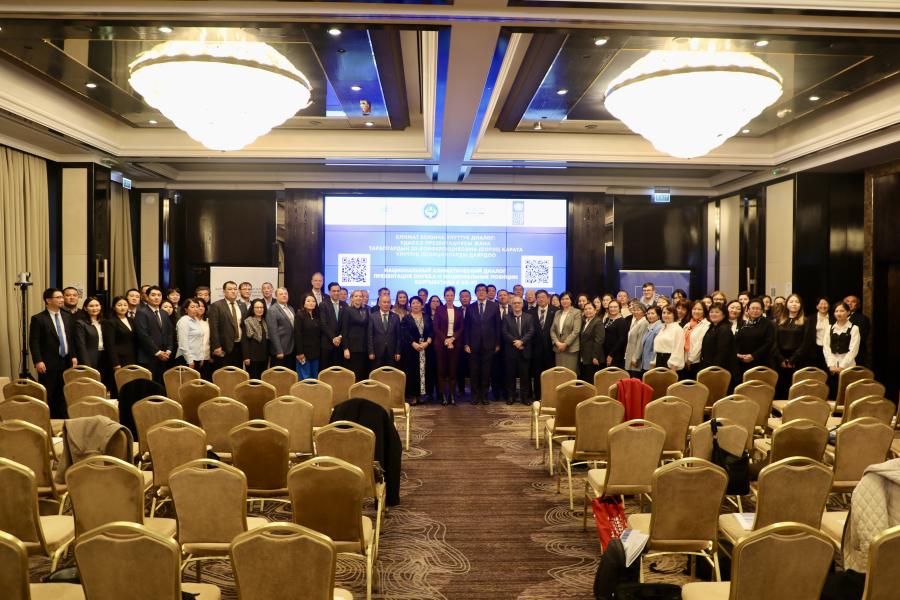
The National Climate Dialogue brought together representatives from government, parliament, local authorities, civil society, academia, business, farmers’ associations, women’s and youth networks, and development partners. Together, they shaped a unified national position that Kyrgyzstan will present at the upcoming UNFCCC Conference of the Parties (COP30) in Belém, Brazil.
COP30 will serve as a platform for advancing collective action to keep global warming within 1.5°C, accelerate climate investments, and translate commitments into concrete results.
Today’s dialogue united voices from across Kyrgyz society — from state institutions to local communities — marking an important milestone on the country’s path toward a consolidated, fair, and ambitious national climate agenda.
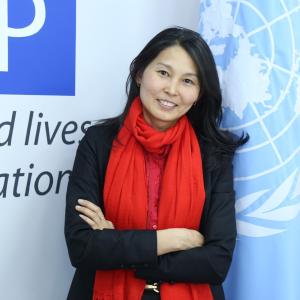
Айнагуль Абдрахманова



Бул демилгеге катышкан БУУ агенттиктери
Бул демилге аркылуу биз колдогон максаттар